Home Blog

ASL Interpreted: Curry Cockle Chow Mein and Night Follows Night
GVAD is sharing this information:
Visual Description of the first image: A pair of hands covered in cuts and drying blood are held, palms facing up, over a table where a pile of freshly cut salmon fillets and a paring knife rest on bloodied cardboard.
Visual Description of the second image: A cast pair of gold teeth rests on a window sill next to a model of a mosque cast in semi-transparent yellow plastic, both objects are dappled in cool sunlight streaming in through the glass.
Western Front and Emily Carr University of Art + Design present Night follows night, and the two and three-stringed instruments talk to each other, a multi-modal assembly in two parts at the end of this month. Both parts include live ASL interpretation.
Part 1: Curry Cockle Chow Mein by Skeena Reece
Date: Thursday, October 29, 2026
Time: 6:30 p.m.
Location: Grand Luxe Hall, Western Front, 303 E 8th Ave, Vancouver
Price: By donation, suggested $15 to $35
Tickets link: https://www.eventbrite.ca/e/curry-cockle-chow-mein-tickets-2002608916177
Livestream link: https://vimeo.com/event/6237212
Conceived as a space of gathering, testimony, and witness, Curry Cockle Chow Mein (2026) draws from the legacies and practices of the potlatch, and Skeena Reece’s Tsimshian, Gitxsan, Cree, and Métis heritage.
This is Part 1 of Night follows night, and the two and three-stringed instruments talk to each other. Part 2 takes place on October 31 at Emily Carr University of Art + Design.
Accessibility: The Grand Luxe Hall is located on the second floor of Western Front, which is accessed by a flight of twenty-six stairs. Events in the Grand Luxe Hall are made available virtually via high-quality livestream.
Accessibility questions: yasminewk@westernfront.ca
Full information: https://westernfront.ca/events/part-1-night-follows-night-and-the-two-and-three-stringed-instruments-talk-to-each-other
Part 2: Night follows night
Date: Saturday, October 31, 2026
Time: 11:00 a.m. to 4:00 p.m. (doors and refreshments at 10:00 a.m.)
Location: Reliance Theatre, Emily Carr University of Art + Design, 555 Great Northern Way, Vancouver
Tickets: Free
Live ASL interpretation will be available for all live talks and in-person performances. Live virtual components will have AI-generated captioning, and screenings will have closed captions.
This is Part 2 of Night follows night, and the two and three-stringed instruments talk to each other, co-curated by Susan Gibb, Vanessa Kwan, and Sadia Shirazi.
Accessibility: The Reliance Theatre is located on the first floor. The building is best accessed from the southwest entrance, which faces Great Northern Way and has automatic double doors. The elevators are down the hall to the right. Gender neutral washrooms are on both the first and second floors.
Accessibility questions: yasminewk@westernfront.ca
Natalie’s All-Abilities Games Club: Inclusive Community Games and Events
GVAD is sharing this information:
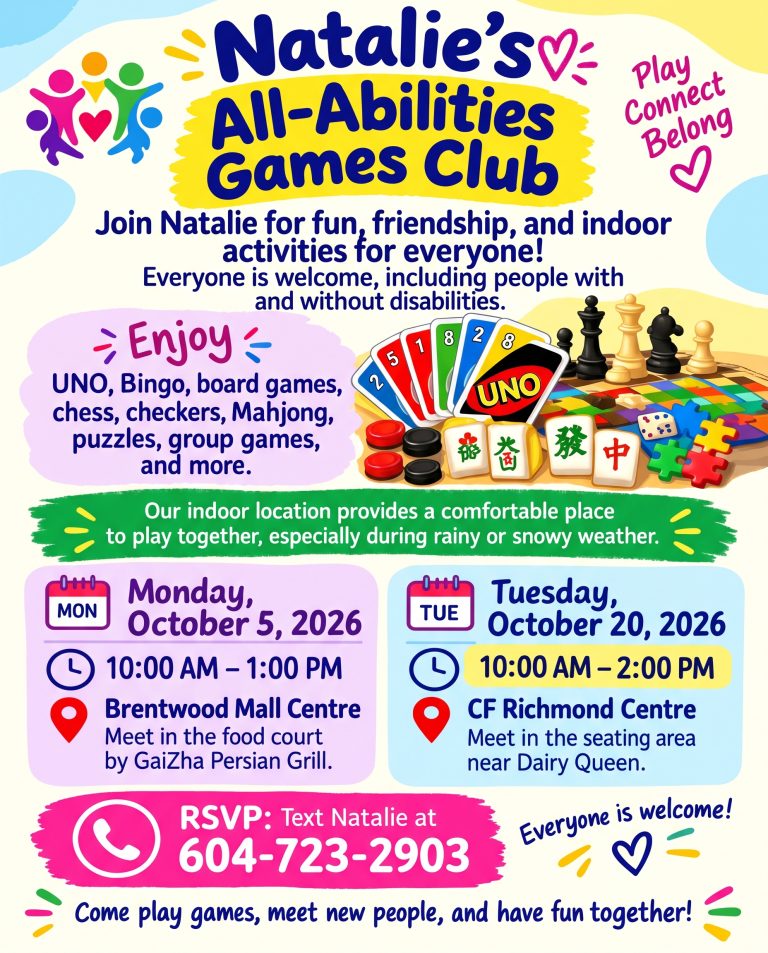
Natalie would like to invite family, friends, classmates, children, seniors, and anyone who would like to participate in her All-Abilities Games Club, with hosted games and community events. Everyone is welcome to join!
Her events are open to people of all ages and abilities, including:
People with disabilities and people without disabilities
Deaf and hard-of-hearing people
Hearing people and hearing families
Seniors and older adults
Wheelchair users and people with other accessibility needs
Children, kids, young adults, and families
People from public or private organizations
Anyone in the community who would like to participate
There is no age limit, and everyone is welcome.
If you are interested in joining or learning more about Natalie’s hosted games, please contact her:
Email: natalie.2010@live.ca or text 604-723-2903
Natalie hopes to welcome many more people to her games and community activities.
GVAD 2026 Special General Meeting
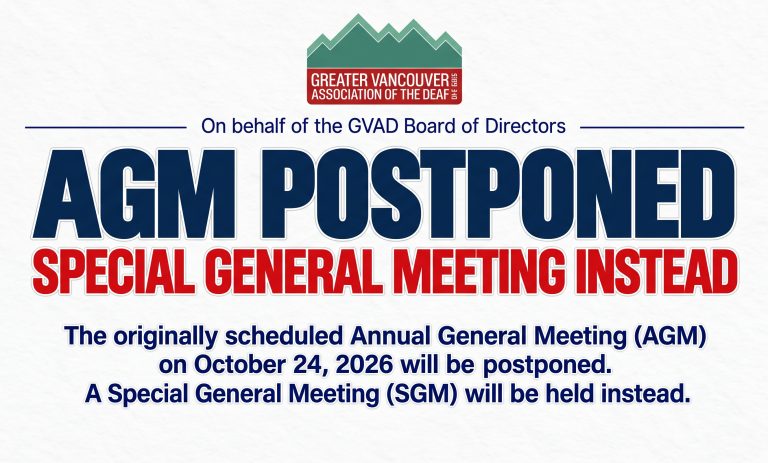
Visual description: A vertical informational flyer on an off-white textured background featuring the GVAD logo at the top, organized into sections with bold navy and red text separated by thin blue rules. The layout arranges meeting headlines, a three-column event details grid, and an emphasized call-to-action above a bottom footer containing RSVP info and a QR code
? Important update for GVAD members.
We at GVAD are changing our meeting on Saturday, October 24, 2026. The Annual General Meeting (AGM) is postponed. We will hold a Special General Meeting (SGM) instead.
Date: Saturday, October 24, 2026
Time: 1:00 PM to 4:00 PM
Location: Douglas College, Theatre N2201
At this meeting, the GVAD Board of Directors will share an important announcement about the future of our association.
Members can get information, ask questions, join the discussion, and vote on matters that need membership approval.
Please make sure your membership is up to date before the meeting.
Membership link:
https://gvad.ca/membership2027
Your presence, voice, and vote matter. We strongly encourage all members to attend. ?
We will share the agenda and voting matters in advance, following GVAD’s bylaws.
SGM RSVP link:
https://gvad.ca/sgm2026
GVAD 2026 Annual General Meeting RSVP
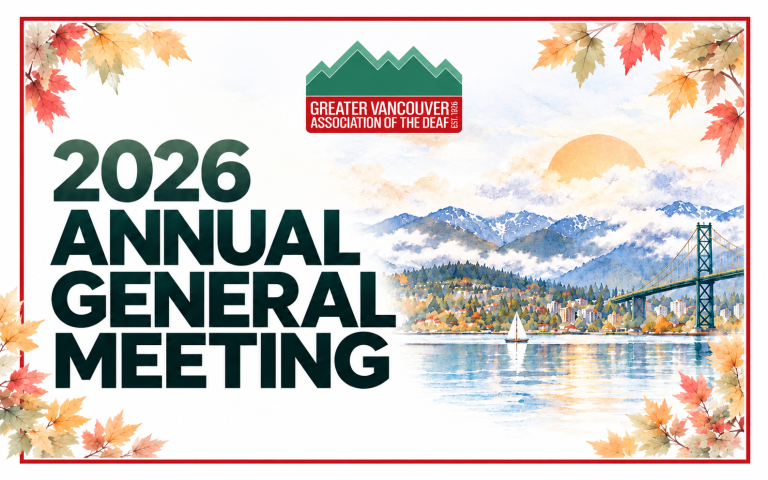
Visual description:
A clean autumn-themed GVAD flyer with a bold “2026 ANNUAL GENERAL MEETING” header beside a soft watercolor Vancouver scene featuring mountains, water, skyline, and the Lions Gate Bridge. Red, green, and navy sections organize the event details, with simple icons, a highlighted RSVP area, QR code, and autumn leaves framing the design.
Event information:
Your voice matters. Your ideas matter. Your membership gives you a voice in GVAD’s future.
Join us at our 2026 Annual General Meeting to connect with the community, hear important updates and reports, and take part in the voting.
Date: Saturday, October 24, 2026
Time: 1:00–4:00 PM
Where: Theatre Room N2201, Douglas College – New Westminster
MEMBERSHIP MATTERS:
The AGM is for GVAD members, and an active membership is required to vote.
Become a GVAD member and be part of the decisions, conversations, and community that shape GVAD.Not a member? Click here to join or renew your membership!
ACCESSIBILITY:
Need accessibility accommodations? Let us know through the RSVP form or email accessibility@gvad.ca.
PLEASE RSVP
Your RSVP helps us plan enough space, food, meeting materials, and accessibility accommodations for everyone attending.
Link to rsvp: https://gvad.ca/agm2026
YOUR VOICE. YOUR COMMUNITY. YOUR GVAD.
Sumain Theatre is Hiring: Creative Process Director
GVAD is sharing this information:
WE’RE HIRING: Creative Process Director
– Artist Fee: $2000
– Travel + Accommodations included
– Open to both Canadian and International Artists
– Must be signed-language friendly
Sumain Theatre is seeking a Creative Process Director to join the development of Monsters We Keep, a new Deaf-led Platform Theatre creation exploring dreams, vulnerability, and the hidden relationships we maintain with the monsters we carry inside ourselves.
This role will support and document the creative process through photography/video, rehearsal documentation, setup, artist support, and our public demonstration, while helping us capture the development of our emerging treteau and visual story methodology.
Monsters We Keep will continue development toward its world premiere in Summer 2027.
– The Artesian — Regina, SK
– January 4–16, 2027
– 10 AM–4 PM
– $2,000 CAD
Public Demonstration: January 16
We welcome emerging artists, photographers, filmmakers, stage managers, arts administrators, and multidisciplinary artists. Applicants should be comfortable working within a Deaf-led, signed language led creative environment.
To apply, send us a short introduction, why this opportunity interests you, and examples of relevant creative or documentation work. Send us an email at sumaintheatre@gmail.com!
Applications will be reviewed as they are received.
Our creative team:
@mustafaalabssi, @s_raet, @fnadia7, @1_i9x1, @landon_krentz (Mustafa Alabssi, Shayla-Rae Tanner, Matty Molloy, Fatima Nafisa, and Landon Krentz)
To be joined by a Deaf theatre research collaborator, Dr. Joanne Weber @joweber49
A huge thank you to @canada.council for funding this project.
Epidermis Circus with ASL
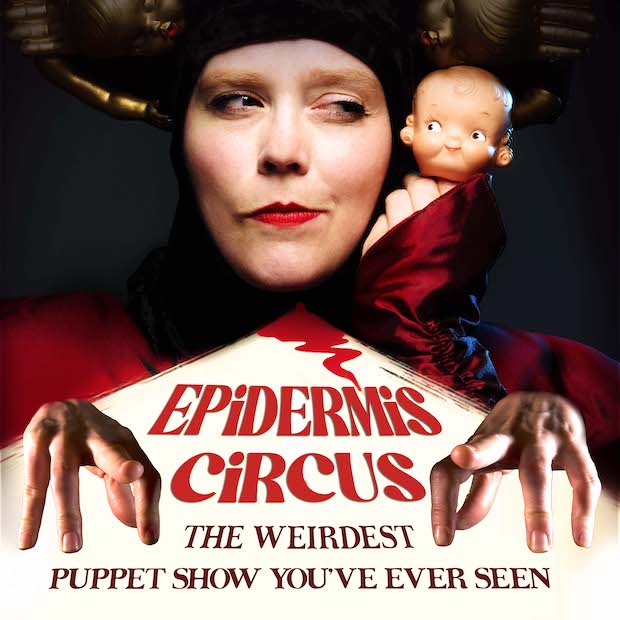
GVAD is sharing this information:
3 ASL interpreted shows with interpreter Joy Emerson this Thursday, Friday, and Saturday!
Thursday, October 1, 2026 at 7:30 PM: Evergreen Arts in Coquitlam, BC
Friday, October 2, 2026 at 7:30 PM: Surrey Civic Theatres in Surrey, BC
Saturday, October 3, 2026 at 7:30 PM: Clarke Theatre in Mission, BC
Hands & Hearts Touchpoint Seniors Conference 2027
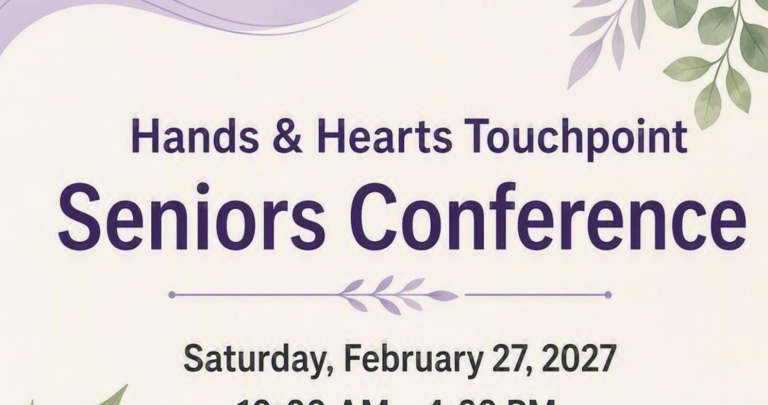
Hands & Hearts Touchpoint Seniors Conference ?
Join us for a welcoming seniors conference focused on connection, community, learning, and support.
Date: Saturday, February 27, 2027
Time: 10:00 AM to 4:00 PM
Location: Bonsor Centre
Save the date. More details to come.
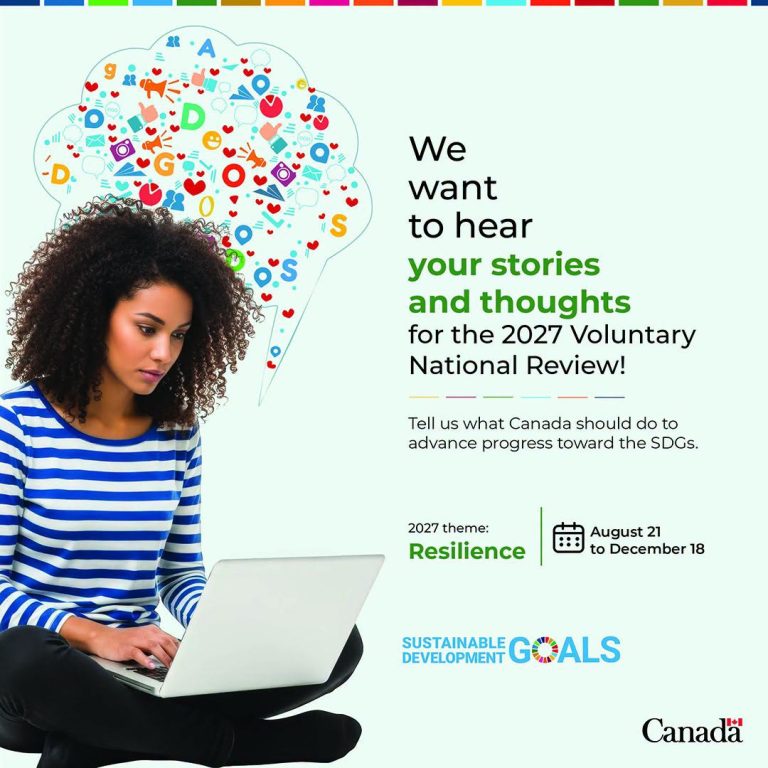
Have Your Say: Contribute to Canada’s 2027 Voluntary National Review
GVAD is sharing this information:
From now until December 18, 2026, Canadians are invited to share their perspectives and help shape Canada’s 2027 Voluntary National Review.
With only four years remaining until 2030, this is a critical opportunity to reflect on progress, identify challenges, and highlight innovative actions that are helping advance sustainable development across Canada. Your experiences, insights, and expertise can help ensure that Canada’s VNR reflects the diverse perspectives of people and organizations working to advance the SDGs.
Get Involved: We encourage you to participate and share this opportunity with your networks. There are a few ways to get involved:
Visit Share your ideas: Contribute to Canada’s 2027 Voluntary National Review to:
- Complete the online consultation to share your experiences, priorities, and recommendations;
- Or learn how to host your own consultation; and submit feedback gathered from your community, organization, or network.
Throughout the fall, additional engagement opportunities will be available, including information sessions and virtual events on Canada’s 2027 VNR.
To learn more, please visit Canada and the Sustainable Development Goals.
Thank you for helping shape Canada’s contribution to the global effort to achieve the Sustainable Development Goals by 2030.
Should you have any questions, please do not hesitate to contact the SDG Unit at Programme2030-2030Agenda@esdc-edsc.gc.ca
ASL Interpretation on request: Lines into the Air Fall 2026 Workshops
GVAD is sharing this information:
Two workshops from Capilano Review Contemporary Arts Society, with ASL interpretation available upon request.
Two workshops from Capilano Review Contemporary Arts Society, with ASL interpretation available upon request.
Fragment & Form: Visual Storytelling through Zines, with bailey macabre
Two workshop options:
Option 1: Saturday, October 24, 1:00pm to 3:30pm
Option 2: Sunday, October 25, 1:00pm to 3:30pm
In-person at grunt gallery, 350 E 2nd Ave, Vancouver
Registration Fee: $20 / Free for Indigenous participants / PWYC. Includes one year print subscription to The Capilano Review.
Please note that registration will close two weeks before each event.
The Sensing Body as Portal, with Guadalupe Martinez
Sunday, November 1, 2pm to 5pm
Sunday, November 8, 2pm to 5pm
In-person at Morrow (Unit 204, 910 Richards Street, Vancouver)
Registration Fee: $45 / Free for Indigenous participants / PWYC. Includes one year print subscription to The Capilano Review.
Register by Sunday, October 18th.
ASL interpretation is available upon request.
Please feel free to reach out to contact@thecapilanoreview.com with any questions.
ASL Presented: Mortgage Renewal Workshop, October 17

Free Mortgage Renewal Workshop
Is your mortgage coming up for renewal? Join Mortgage Agent Fowad Nisar for a free online workshop covering when to start preparing, how to compare your options, and what to consider before accepting your lender’s renewal offer.
The workshop will be presented in ASL with English interpretation.
Saturday, October 17, 2026
11:30 AM to 12:30 PM ET | Zoom
Can’t attend live? Register and you’ll receive the replay.
Register: fowad.ca/renewa
ERA’s Computer Grant Program
GVAD is sharing this information:
Looking to give your old technology a second life?
ERA’s Computer Grant Program helps connect donated electronics with charities, schools, nonprofits, and community organizations that need them.
Organizations can apply for technology, and donors can view current requests and help support a specific need.
Learn more: https://www.era.ca/donate-to-charities/
GVAD: Gary Malkowski Film Screening, September 22
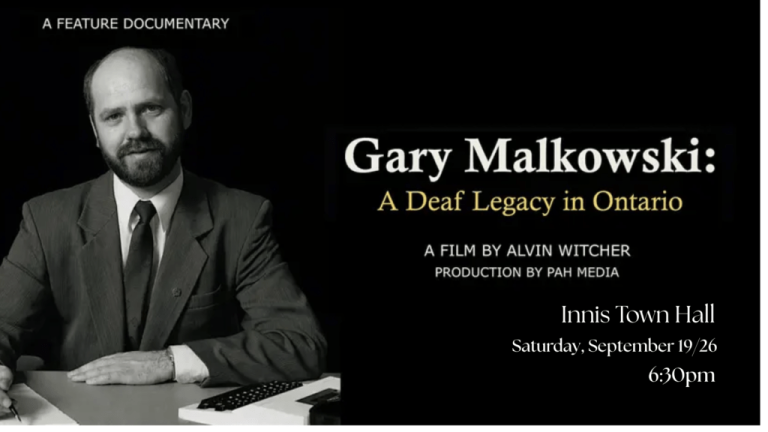
Join GVAD and the British Columbia Association of the Deaf for a limited time private screening of Gary Malkowski: A Deaf Legacy in Ontario, winner of Best Feature at the Clin d’Oeil Festival in Reims, France. This screening is part of International Week of Deaf People, celebrating Deaf culture, leadership, and history.
Date: Tuesday, September 22, 2026, 6:00 PM to 9:00 PM
Location: Douglas College, New Westminster Campus,
700 Royal Avenue, New Westminster, BC
Admission: $10
? Tickets: https://bit.ly/garymfilm-gvad
BCCSD: Letter from Mark Carney
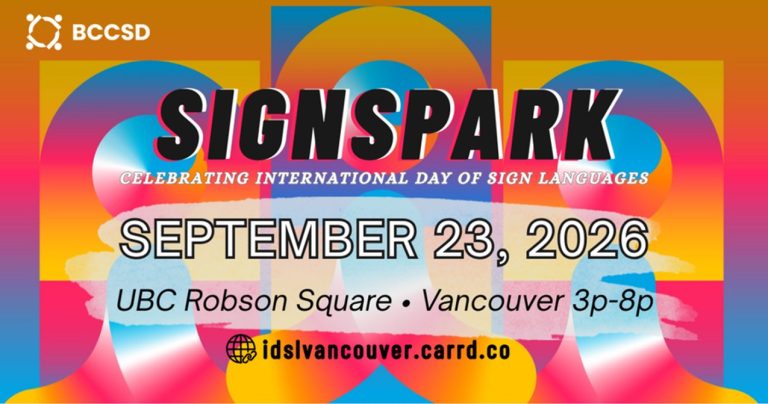
The Right Honourable Mark Carney, Prime Minister of Canada, sent a letter extending his warmest greetings to everyone marking the International Day of Sign Languages. In it, he reflected on the many contributions Deaf Canadians make to society, thanked the British Columbia Cultural Society of the Deaf for their commitment to advocating for Deaf Canadians, and wished everyone a memorable event.
?Join BCCSD at SignSpark to celebrate!
Date: September 23, 2026, 2:00 PM to 8:00 PM
Location: UBC Robson Square, 800 Robson Street, Vancouver, BC
?GVAD’s Director at Large, Lisa Anderson, will take the stage at 3:30 PM to present “What is IDSL?” as part of the Spark Lab workshop in the room C100. Come to learn why this day matters!
The evening showcase features performances by Deaf and Hearing artists, including a reading of the Prime Minister’s letter by Gregory Desrosiers.
More details: https://idslvancouver.carrd.co/
DWBP: Indigenous Deaf Gathering – Oct 1
GVAD is sharing this information:
Image Description:
This is a promotional flyer titled “Indigenous Deaf Gathering: Orange Shirt Day.”
The top section’s graphic features a smooth gradient transitioning from deep crimson red at the top to a warm, glowing amber orange at the base. Centered in the lower half is a stylized Indigenous emblem rendered in delicate, semi-translucent tones. The motif portrays two adult figures facing inward, gently embracing two small children in their arms, flanked by arching tree branches and seed-like dots beneath. Above the figures rests a circular medallion depicting an eagle feather and cultural symbols set over an evergreen bough. The monochromatic palette and protective composition evoke a solemn, reflective, and nurturing mood of cultural remembrance. Bold white headline text is on bottom of the graphic.
The middle section has a white background with blue and black text detailing an event recognizing the National Day for Truth and Reconciliation.
A teal footer at the bottom includes the Vancouver Coastal Health logo and sign-language hands illustration spelling out “WBP”.
Text version:
Indigenous Deaf Gathering: Orange Shirt Day
Activity in recognition of National Day for Truth and Reconciliation
Indigenous Deaf community member Andrea Wilson will provide a beading activity to make Orange Shirt Day pins.
This activity is for Indigenous Deaf and Hard of Hearing community members age 13+. We will learn about beading and talk about National Day for Truth and Reconciliation. The activity will be in ASL.
When: Thursday, October 1st – 4 to 6 pm
Where: Deaf Well Being Program at 300-4211 Kingsway in Burnaby.
Registration is required so we can have enough beads for everyone.
Email: alison.nutt@vch.ca
Text/Video: 778-987-4162
INFO SESSION on Oct 1st, 2026: Learn about the new patient online booking system
GVAD is sharing this information:
(ASL VERSION: Watch here https://vimeo.com/1227502456/d3eff94d43)
INFO SESSION
Learn about the new patient online booking system
Provincial Language Services (PLS) has launched Communication Access Services (CAS), a new online booking system that makes it easier for patients to request services such as sign language interpreting, intervenor services, and Communication Access Real-time Translation.
What’s new?
Appointment reminders by email and text message
Ability to track service requests
Centralized provincial coordination of services
Starting October 5, 2026, all service requests will be coordinated through PLS.
Event details:
Join our hybrid information session to learn about CAS, ask questions, and meet the PLS team.
When: Thursday, October 1, 2026 at 6:00 pm – 8:00 pm (doors open at 5:30 pm)
Where: 1795 Willingdon Avenue, Burnaby, BC or online via Zoom
RSVP online by September 29:
For more information, contact: